
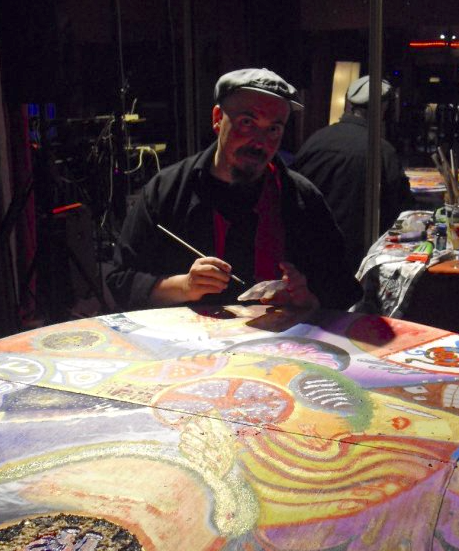
I participated in my first sand mandala under the tutelage of visiting Tibetan Monks in 1995; it left as lasting impression on my artistic missions. Inspired to propagate associated lessons and articulate them among the creative communities of Berkeley and Oakland, I launched the I’mandala series. An immersive collective work of interactive art, the I’mandala project began in 1998 and continued through 2014.
Originally titled Interactive Community Mandala Project, the I in Imandala has come to mean more than interactive. Information, inspiration, integration and individuation all exist as subjects of dialog and contemplation within each work. Also called I’mandala to instill a sense of identity with the process becoming a part of a greater whole.

The very first Interactive Community Mandala Project began with the goal of presenting a visual key to the process of non-violent conflict resolution. The eight feet tall by eleven feet wide canvas featured a simple mandala graphic with a twelve inch grid superimposed. A corresponding sign up sheet was made available providing a system for people to claim any one of the eighty-eight specific cells, within the mandala grid. Participants were free to complete their “square,” coloring in and embellishing upon the mandala graphic using the provided art supplies.
The sign up sheet afforded each participant the opportunity to treat their individual cell as an autonomous canvas, adopting or rejecting design elements from adjacent cells according to individual tastes or interaction with one’s neighbors. The project remained available for six months, from January 1998 to June 1998, receiving many repeat visits and a total of over Thirty participants. It was a profound success leading to unique resolutions for those involved and bringing about an ongoing dialog regarding the use of color, shape and image as components of a nonverbal language. This dialogue continued with a second I’mandala, organized at a daytime event at what is now the headquarters of the Kala Art Institute, in Berkeley CA. This I’mandala was available to individuals numbering in the hundreds and was presented alongside the completed first piece.


After the first two iterations, the grid system was dropped. Consequentially, mandala design elements evolved in relation to the reaction of participants. Not one participant could truly know how the mandala’s innermost center or outermost ring would ultimately appear. Over the following decade, subsequent Imandala installations were created free standing. In the year 2000 a Burning Man theme camp featured an Imandala as its central point of interaction.
With very few exceptions, the I’mandala was typically painted on a vertical plane. While this allowed participants to step back and observe the process of creation, interaction was either side-by-side or front to back. While available step-stools allowed even the smallest participant to reach the upper portions of a large Imandala, the end result was consistently a circular mandala imbedded upon a rectangular canvas. Recurring design themes would often reveal themselves by their location on the canvas; one example which could be found in the examples above could be the attention devoted to the top right corners.

In March of 2008, ten years after the creation of the very first piece, a new method of creating an I’mandala was introduced; painting upon a canvas stretched on a circular table. In this way the I’mandala returned to the roots of mandala creation. Similar to Tibetan sand painting, participants could now gather in a circle, facing one another and working collaboratively. With no corners, or top and bottom, the entire Mandala was given equal prominence, its center equally in reach to all participants.


Reframing techniques and the cultural practice of a mandala meditation for modern engagement in the Bay Area’s diverse population provided an experiential frame-work for communicating Buddhist and Hindu cosmology. A salient example of revelations offered to participants is the detachment from outcome. Though this communitarian engagement the finished piece is discovered rather than created. Lessons in co-creation and shared aesthetics remain captured on the canvas. To Date 13 Mandalas have been created.Hundreds of people in the Bay Area and beyond have contributed.
Discover more from
Subscribe to get the latest posts sent to your email.